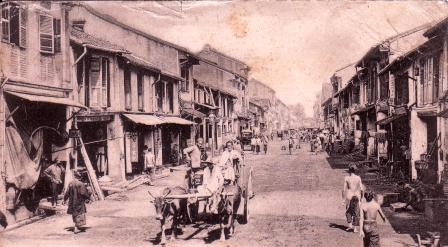
I'm sure you're wondering by now; why did I post all that information? Well, because of one simple reason - I'd like to stress the importance of conservation in Singapore. In today's rapidly changing landscape, Singapore is clearly in danger of losing its deep cultural identity which used to show so much in the past. Chinatown is an excellent example, as I will now illustrate.
As mentioned clearly in the last few posts, Chinatown today is very different from the past. Here are the main differences illustrated below:
1) Chinatown used to sell hawker food on the streets for its residents in the past - much like the neighbourhood hawker centres of today, residents would just sit down and eat. Today, hawker food is available in a designated street, aptly named Chinatown Food Street. The food here is priced at tourist prices and sold in pushcart-like stalls reminescent of the past(Fig. 1); all the food here has some kind of claim to its name or other, such as Green Book awards or some information about the history of the dish pasted neatly at the storefront. Today, most of the patrons here are tourists - Singaporeans know they can find the same food at cheaper prices at nearby hawker centres.
2) Chinatown used to be home to the Chinese population of Singapore; it was a close-knit community and neighbourhood. Today, the few original residents that remain live around Sago Street; houses cannot be found around the rest of the area anymore. Most of the early shophouses from the 1800s still stand but they have been freshly repainted and restored and are now empty, only adding to the aesthetic and nostalgic appeal of Chinatown.
3) Chinatown used to have many shops selling everyday wares for the Chinese, from traditional wedding gifts to high-quality imitation antiques. Today, Chinatown mostly comprises tourist giftshops selling iconic Singaporean souvenirs with icons such as the Merlion or Singlish phrases on them (see Fig. 2) and traditional-looking shops which, looking closer, cater to tourists (like the clothes-shop in Fig. 3) A few traditional shops, mostly selling antiques, still exist (Fig. 4, Fig. 5) but many traditional goods still cannot be found unless you visit Sago Lane, where a few of the old shops remain alongside the houses. Just beside the traditional-looking streets, modern buildings such as the People's Park Centre stand(Fig.6) - this is where most of the older locals do their shopping in Chinatown nowadays.
From here, the changes are apparent - but what importance do these changes hold, so much that conservation is necessary? Well, these physical changes also affect the identity of Chinatown - they affect how Singaporeans and tourists alike see Chinatown.
Though non-residents saw Chinatown as dirty and messy in the past, a slum of sorts, they recognised it as the residential area of the Chinese back then - Chinatown was associated with the Chinese of early Singapore. To the residents, Chinatown was so much more - it was their home. Integral to their survival, Chinatown was where they lived and where their businesses flourished. Furthermore, Chinatown was where their close-knit community was, where the spirit of togetherness was particularly strong. To the residents, the less-than-desirable sanitation posed little of a problem. In the 1800s, Chinatown embodied the Chinese population of Singapore.
Today, tourists see Chinatown as a window into Singapore's past - a depiction of Chinese life back then and of the traditions we once observed. Chinatown is popular among tourists here since it offers a refreshing change from the urban landscape of Singapore. However, today's generation of Singaporeans don't see Chinatown as much more - to us, it's a tourist hotspot and an interesting place to learn about our past, especially to the Chinese Singaporeans of today. However, most of us rarely visit Chinatown, with the exception of mandatory school trips and perhaps during the Chinese New Year shopping period. Few Singaporeans actually remember what a big part Chinatown used to play in the identity of the Chinese here. The few left with memories of the past see Chinatown as a faint reminder of it - many feel that the place has lost its 'soul' and glory of the past.
I hereby stress on the importance of conservation; this change in identity is worrying. For most Singaporeans now, even for the Chinese, Chinatown reflects what the past had been like - it is indeed an interesting portrait of the way of life back then. However, hardly anyone can truly say they have an emotional attachment to the place, save the older citizens who were once residents of the area or lived before urban renewal was carried out. Though urban renewal was a good step forward for Singapore's development, it diminished the precious community spirit found in the old Chinatown - few Singaporean residential areas today, if any, can boast of the same spirit. The deep significance of Chinatown in Singaporean Chinese's lives can never be revived as well.
However, conservation will definitely be able to stop the cultural significance of places like Chinatown from slipping or diminishing further. For the case of Chinatown, simply encouraging traditional businesses and residential areas to flourish would not suffice. Effort has to be made for the preservation of the place's identity - for example, the government can hold cultural events at parts of Chinatown a few times each year, with sufficient advertising to ensure turnout. Also, we should consider lowering the costs of food sold in Chinatown Food Street - in order to get vendors to do this, we should first lower the rental costs of setting stores up there - this will encourage more locals to dine there alongside tourists, hence inviting locals to visit Chinatown more often.
The most important part of conservation for Chinatown would be to preserve the traditional structures there, such as the old shophouses. In future urban renewal movements, I strongly feel that these structures should remain untouched in the least, if not restored and repainted. Much of Singapore's traditional infrastructure has been torn down in the name of progress, but there are parts of our culture that I feel must be retained. If people forget the heritage of their own country, the very 'soul' of life in that place is lost.
With conservation efforts in place, we will definitely be able to preserve our identity and culture and revive the cultural vibrancy of Singapore - or at least prevent it from being diminished any further.